
Duchesne County Sex Offender Checks
The public route for Duchesne County is the Utah Sex, Kidnap, and Child Abuse Offender Registry. The Utah Department of Corrections manages the Duchesne registry data with help from registering law-enforcement agencies. Its public SONAR service is distinct from a Duchesne criminal court docket, a county jail booking, and a Bureau of Criminal Identification history. SONAR answers a focused local safety question by publishing the fields Utah law permits for registered people.
Start with the Utah registry for a Duchesne name or postal-code check. Use the National Sex Offender Public Website when a Duchesne search may cross state, territory, or tribal lines. For suspected noncompliance, contact the Duchesne County sheriff or Utah registry staff instead of trying to investigate. The Duchesne registry phone is 801-495-7700.
A Duchesne self-record request to BCI serves a different purpose. The official BCI self-record instructions pictured below concern a person's own Utah criminal history, not a public Duchesne registry search.
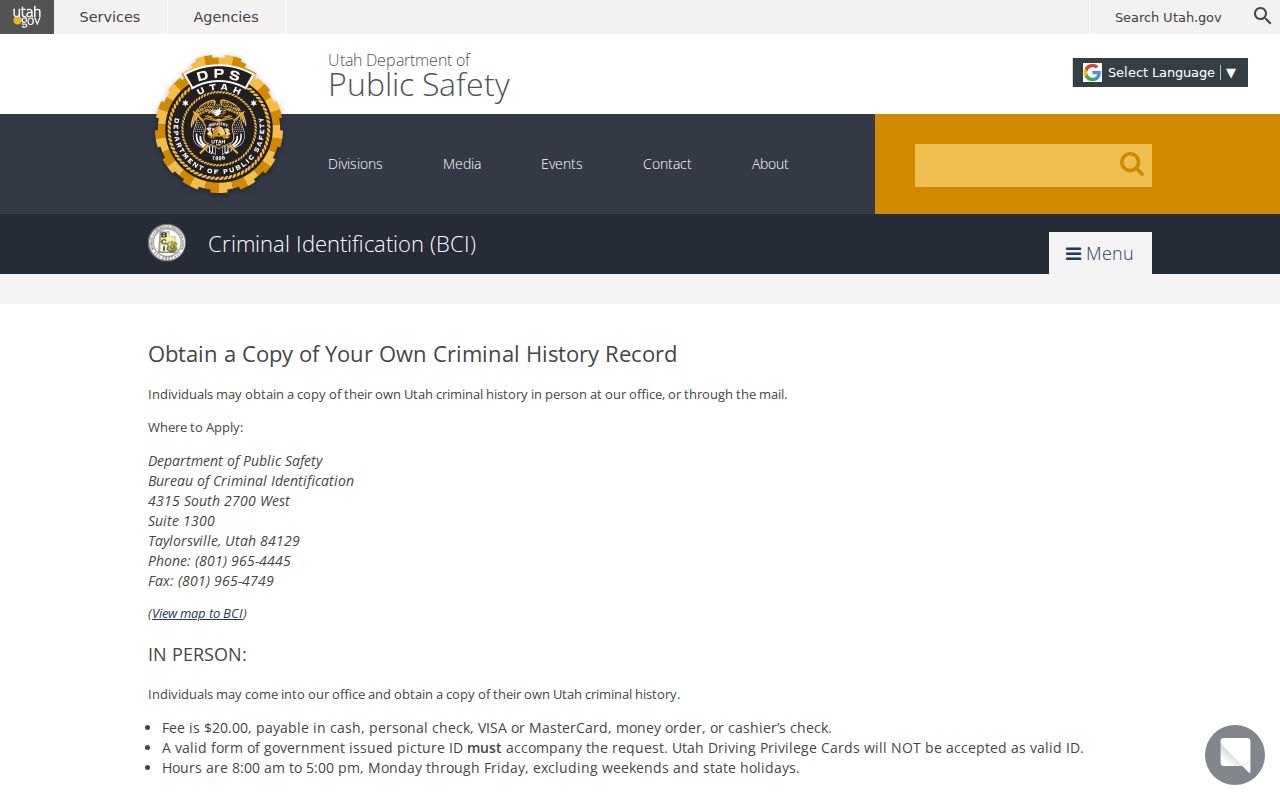
That difference keeps a Duchesne County registry check tied to the public safety system while personal rap-sheet review remains with BCI's fingerprint-supported process.
Duchesne County Registry Safety Agreement
The UDC-linked public portal requires a local user to accept a disclaimer before entering the search. The agreement says registry information comes from registrants and that accuracy or completeness is not guaranteed. It also warns that harassment, stalking, or threats against a registrant or the person's family are prohibited and may violate criminal law. These are not minor notices to click past. They set the lawful frame for every Duchesne County registry search.
Use a Duchesne result as a prompt for sound safety steps, not confrontation. Compare names, aliases, photographs, physical features, and published Duchesne locations before deciding that a profile concerns the right person. If a Duchesne detail seems stale or a required address appears wrong, send the concern to law enforcement or registry staff. Direct contact can put people at risk and may interfere with a Duchesne compliance inquiry.
Utah Sex, Kidnap, and Child Abuse Offender Registry Searches
The Utah public offender registry is the main statewide channel for Duchesne searches. Utah law confirms indexing by surname and postal code, plus reverse checks for a telephone number, online identifier, or website. The live Duchesne interface should be read as it appears because control labels can change. A reverse result is intentionally limited: it tells whether the searched Duchesne criterion is linked to an offender but does not reveal that person's identity through the reverse tool.
- Open the official registry and read the safety disclaimer before accepting its terms.
- Use a surname or postal code to find relevant public profiles in or near Duchesne County.
- Compare the published photograph, aliases, physical details, address, vehicle, and offense information.
- For a Duchesne telephone number, online identifier, or website, use the reverse check and respect its identity limit.
| Search criterion | Type | Required | Result limit |
|---|---|---|---|
| Surname | Public index | Portal-defined | Returns matching public profiles |
| Postal code | Public index | Portal-defined | Finds profiles tied to the selected area |
| Telephone number | Reverse check | One criterion | Confirms a link without revealing identity |
| Online identifier | Reverse check | One criterion | Confirms a link without revealing identity |
| Website | Reverse check | One criterion | Confirms a link without revealing identity |
Duchesne County Registry and NSOPW
The Utah registry is the best first source for a Duchesne County location because Utah agencies manage the underlying Duchesne duty. The National Sex Offender Public Website, operated by the U.S. Department of Justice, adds a cross-state layer to the Duchesne search. NSOPW is useful when a person has moved, when a Duchesne address lies near a state boundary, or when the relevant jurisdiction is uncertain. It should supplement the Utah entry rather than erase a conflict between Duchesne sources.
The official national interface is shown below with its own search and safety resources.
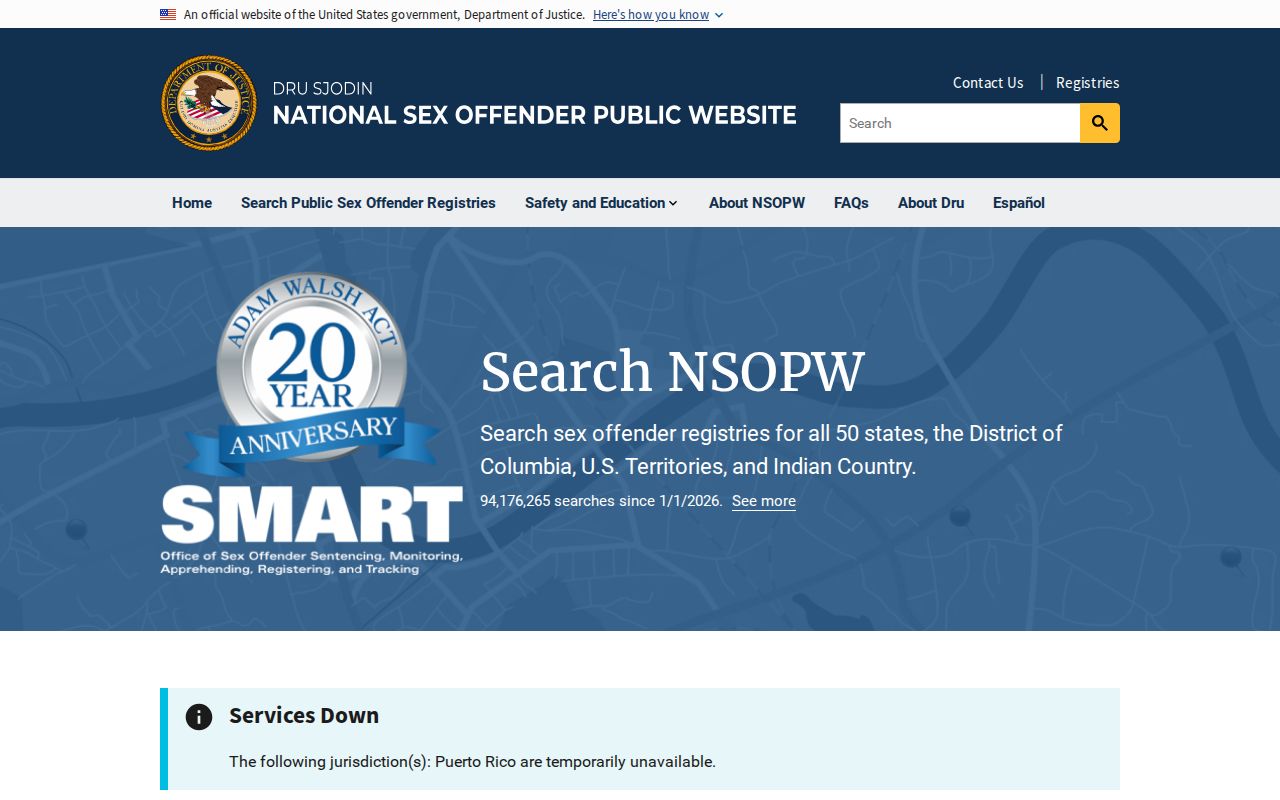
If NSOPW and the Duchesne entry appear to differ, return to Utah registry staff or the registering agency. A missing national result does not prove that no Duchesne registration duty exists, and a national match still needs careful Duchesne identity review.
Registry Profiles: What They Show
Utah Code Title 53, Chapter 29 defines the Duchesne public fields rather than leaving publication to guesswork. A Duchesne County public profile can combine identity, place, appearance, vehicle, and offense data. Victim-identifying information must be removed from the Duchesne display. The profile is not a full Duchesne police file, risk forecast, or complete criminal history.
| Names and image | Current name, aliases, and a current photograph help confirm identity. |
|---|---|
| Addresses | Utah primary, secondary, and temporary addresses can appear, along with out-of-state addresses. |
| Physical description | Date of birth, height, weight, eye color, and hair color may be published. |
| Vehicles | Make, model, color, year, and license plate can identify registered vehicles. |
| Registrable offenses | The profile identifies offenses and other information selected under department rules. |
| Specified affiliations | Professional licenses and certain school or volunteer affiliations may be published when the statute calls for them. |
| Victim details | Information that identifies a victim must be redacted from public display. |
Read the Duchesne fields as a set. A shared name is not enough. A Duchesne photograph, alias, birth date, vehicle, and location can help prevent a false match, while the offense and registration period explain why the Duchesne profile is public.
Duchesne County Registry Reverse Searches
Utah's registry reverse tools have a narrow safety purpose. A person may check a Duchesne telephone number, online identifier, or website to learn whether that criterion is linked to an offender. The Duchesne result does not identify the registrant. That boundary lets the system warn about a listed contact point without turning the reverse function into a way to expose someone's full Duchesne registry profile.
Do not try to defeat the identity limit by combining the Duchesne reverse response with rumors or unverified posts. If a reverse check raises a real Duchesne concern, preserve the exact criterion and contact law enforcement or the UDC registry. Staff can assess Duchesne compliance through official information that is not part of the public display. The public user should not impersonate a registrant, make contact, or publish an accusation.
Note: A positive reverse result confirms only that the searched criterion is linked to an offender; it does not identify that person.
Registration Levels and Duties in Utah
Utah does not present its Duchesne public registry through federal Tier I, Tier II, and Tier III labels. State law instead assigns a Duchesne registrant a ten-year or lifetime period based on the listed offense and other statutory facts. A person from another jurisdiction may remain subject to that jurisdiction's continuing period after moving to Duchesne. Courts also have limited power to reduce a lifetime Duchesne duty to ten years for a qualifying person who was under 21 at the time of the offense after reviewing the required factors.
| Utah duration | Who it covers | Public visibility note |
|---|---|---|
| Ten-year | Offenses listed in §53-29-203(1)(a) | The period runs after sentence termination as the statute defines |
| Lifetime | Listed serious offenses and repeat-registration predicates | The duty continues for life unless a statutory reduction applies |
| Other jurisdiction | A person with a continuing registration period elsewhere | The other jurisdiction's period can govern; otherwise Utah's period applies |
| Limited reduction | A qualifying person under 21 at the time of the offense | A court may reduce lifetime duty after statutory factor review |
A qualifying person who was under 18 at the offense may remain maintained in the system but not be publicly posted under the visibility exception. A missing Duchesne public profile can therefore reflect a legal publication limit rather than an absence of agency records.
Duchesne County Registry Custodians
Duchesne responsibility shifts with custody and supervision. The Duchesne County sheriff has registration duties for a Duchesne jail registrant who is not in UDC custody. The Utah Department of Corrections handles Duchesne people during probation, commitment, parole or release, and other supervision transitions. Duchesne courts support the process by transmitting judgment and sentence information within three business days.
This Duchesne split explains why the public portal is statewide even though local law enforcement remains part of the system. It also gives a clear fallback when a Duchesne public profile looks wrong. Contact the agency tied to the person's present status, or call the UDC registry at 801-495-7700. For a Duchesne compliance concern, sheriff or dispatch can route the report. Do not assume the county clerk can change a Duchesne registry profile merely because a conviction began in court.
Using Registry Information Lawfully
Duchesne registry information supports personal, family, and community safety. It can help a Duchesne resident review a nearby published location, recognize an official photograph, or decide whether to call an agency about a possible error. Accuracy still requires restraint. The portal warns that its data comes from registrants and may be incomplete. Verify a consequential registry detail through the registry or registering agency before acting.
Utah Code §53-29-404 authorizes public search and requires the anti-harassment warning. The victim-redaction and limited reverse-search rules also show that public access has firm bounds.
Misuse is prohibited: Utah law forbids using registry information to harass, stalk, threaten, or intimidate a registrant or family member, and such conduct may be prosecuted as a crime.
Duchesne community awareness works best when the public uses the official system, follows the warning, and lets trained agencies handle compliance. A Duchesne registry entry does not authorize surveillance, confrontation, threats, or publication of protected victim information.
Report Duchesne County Registry Concerns
When a Duchesne County profile appears to have an outdated address, the safe response is to record the public Duchesne details that prompted concern and contact the sheriff, dispatch, or UDC registry. Explain the specific Duchesne mismatch without adding guesses. Registry staff can compare the report with Duchesne registration records and decide whether follow-up is needed. For a Duchesne concern spanning another state, use the appropriate state contact reached through NSOPW.
Do not announce that a person is noncompliant based on one observation. Temporary and secondary Duchesne addresses may be valid, publication can lag, and statutory visibility exceptions can affect what appears. The public does not see the Duchesne agency's entire file. Report facts, preserve distance, and call emergency services if there is an immediate threat.
Utah Registry
Utah Department of Corrections
State registry assistance
801-495-7700
Duchesne County Sheriff
Official sheriff channel
Local compliance reports
Use sheriff or dispatch routing